
Navigating the SEND landscape, with Erica Wolstenholme
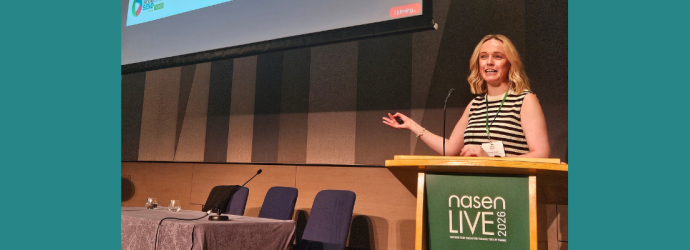
In her Whole School SEND session at nasen LIVE 2026, Erica Wolstenholme, National Coordinator at Whole School SEND, named the thing everyone in the room was already feeling. This is a landscape that is shifting fast, and leaders need both clarity and something they can actually do. She structured her session around three things: the big picture, the forces driving reform, and the practical tools that help us navigate.
She began with an image of a calm sea, and a gentle warning that the sea does not always stay calm. Those of us who work in schools know the choppiness well, and know how precious it is to find moments of calm within it. With three questions in mind, what is changing, what is emerging, and what leaders need to do next, she invited the room to talk to one another, because networking and shared thinking are among the most valuable things a day like this offers.
Then she turned to the data, because you cannot navigate what you do not know. The most recent figures show the proportion of pupils with an EHCP continuing to rise, and the proportion on SEN support rising too, so that around one in five pupils in our schools is now identified with some form of SEN. Nationally, more than 1.8 million pupils are identified with SEND, a figure that has climbed year on year, and outcomes, including for health and wellbeing, remain significantly lower than for their peers. The most common area of need for those with an EHCP is autism, and for those on SEN support, speech, language and communication needs.
Her challenge to leaders was searching, and it applied to leaders at every level, from chief executives and headteachers to teachers and teaching assistants, because all of us lead provision for the children in front of us. Do you really know your school's context against the national picture, she asked, across identification, attendance, attainment and outcomes? Data alone is not enough, but knowing it is where the journey begins.
From there, Erica mapped the forces driving reform. She acknowledged the sheer density of the policy landscape, joking that one of her own slides looked like cognitive overload, before drawing out what it really shows: the many frameworks leaders must navigate at once. She highlighted the Sutton Trust's work on double disadvantage and the concept of doubly disadvantaged learners, those with SEND who also face additional disadvantage, and the questions the forthcoming white paper raises for all of us. Across the reforms she saw recurring priorities: workforce development, curriculum and accountability, a shared language for progress, joined-up systems, and time for implementation. This, she said, is system change, not isolated adjustment.
She could not discuss the forces driving reform without the renewed focus on inclusion running through the Ofsted toolkit, with inclusion threaded through every part of inspection: how well disadvantaged learners and those with SEND are supported, whether curriculum adaptations are meaningful, and how early and accurately schools identify need. And she drew on the concept of intersectionality from the Whole School SEND teacher handbook, the recognition that children do not experience needs in isolation, and that overlapping vulnerabilities deepen the barriers they face.
Through all of it ran a single thread. Inclusion is driven by culture, not just structures, and that culture is built through professional development. When we invest in our staff, outcomes improve. It is why we hold to the strapline: every leader a leader of SEND, every teacher a teacher of SEND.
Making that real, Erica argued, comes down to teacher confidence, and she was careful to insist this is not a soft metric. Teacher self-efficacy, the belief that I can make a difference, is transformational, leading to persistence, creativity and better outcomes. It is the I can that must precede the I will, the shift from this is too complex to this is a problem I can solve. She pointed schools towards a tiered approach to building that confidence, from the EEF's evidence, with new guidance on inclusive practice expected soon, to guidance on inclusion in practice, and the work Whole School SEND supports nationally.
She was specific about what the renewed inspection focus will look for in practice: high expectations, early and accurate identification, a clear plan, do, review cycle, specialist input where it is needed, and genuine partnerships with families. These are not new ideas. They are the fundamentals of effective, inclusive practice, and Erica's point was that they now run consistently through the policy documents and frameworks shaping our work, which should give leaders confidence that the direction of travel is coherent.
She also drew on recent recommendations for schools and trusts, and a message she clearly held close: provision for learners with SEND must be embedded, not separate. The barrier, she suggested, is often teacher confidence, and the shift we need is from hearing this is too complex to hearing I can make this work. That, in turn, points to a more distributed model of leadership, one in which inclusion really is everyone's responsibility, not the SENCO's alone, and in which every adult is supported to build the belief that they can make a difference.
Running through her evidence was a consistent set of themes: early identification, teacher expertise at the centre, the power of relationships, and whole-school approaches that create a genuine sense of belonging. This is joined-up, evidence-informed practice, and it works best when it is owned by everyone.
More than 300,000 professionals have now engaged with Whole School SEND. But engagement, Erica reminded us, is not the goal. Impact is. Attending a webinar, or a conference like today, is not enough on its own. The difference is made when that learning changes what happens in the classroom, for real children, every single day.