

About the Inclusive Practice Hub
A practical space that connects high-quality research with everyday classroom decisions - so inclusive practice is easier to plan, embed, and sustain.
The Inclusive Practice Hub brings together research, case studies and practical strategies for improving SEND provision - in the classroom and across whole-school planning.
Whether you’re reviewing what’s in place or exploring next steps, you’ll find clear, evidence-based guidance to support action and impact.
The Impact Framework
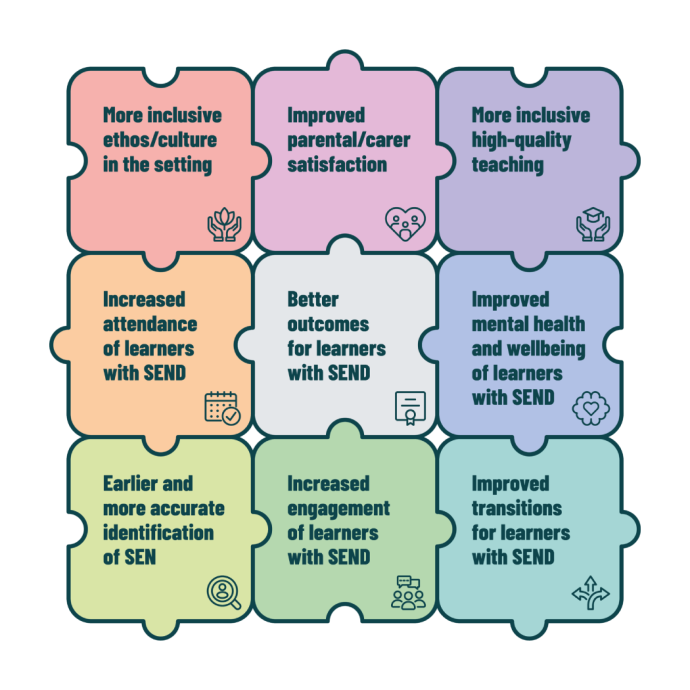
Inclusive practice works best when it’s approached as a connected whole — like a jigsaw, where each piece strengthens the others. This holistic framework helps settings identify priorities, choose relevant evidence, and take consistent steps towards sustainable improvement across:
- More inclusive ethos/culture in the setting
- Improved parental/carer satisfaction
- More inclusive high-quality teaching
- Increased attendance of learners with SEND
- Better outcomes for learners with SEND
- Improved mental health and wellbeing of learners with SEND
- Earlier and more accurate identification of SEN
- Increased engagement of learners with SEND
- Improved transitions for learners with SEND
How to Use the Inclusive Practice Hub
The hub helps you explore evidence, case studies and practical strategies you can apply across classrooms, phases and whole-school improvement. Created in collaboration with Camtree, it supports confident decision‑making for those working with learners with SEND. Use the filters to find what fits your setting, then take clear next steps using the suggested actions and tools.
A Note on Context: We recognise that every school and college is unique. The improvements documented here are rarely the result of a single professional development activity; they are influenced by a wider range of factors including: external specialist support, individual learner circumstances, and the hard work of the setting itself. We do not suggest that these interventions can simply be "lifted and dropped" into another school. Instead, use these case studies to prompt reflection. Ask yourself: How could the principles behind this success be adapted to fit our context? What can we do differently to enable our learners with SEND to thrive?
Built in partnership with Camtree
Camtree, the Cambridge Teacher Research Exchange, exists to promote, support and publish ‘close-to-practice’ research carried out by educators. The Camtree Digital Library publishes peer-reviewed research reports produced by educators from around the world


Share Your Findings
Inclusive practice grows stronger when we learn from one another.
Soon, you’ll be able to share your own research, case studies and approaches with the Nasen community - helping to build a richer picture of what works, for whom, and in which contexts. If you’d like to contribute in future, keep an eye out for submission guidance and collaboration opportunities.
Additional Resources

Inclusive Practice Hub Case Study Template
An editable template to help you write up and share your inclusive practice as a case study for the Whole School SEND Inclusive Practice Hub.

Close-to-Practice Research: Ethical Considerations
An editable checklist to help you make sure your close-to-practice research is manageable, fair and appropriate before you begin or share it.

Webinar: Developing Inclusive Practice Through Close-to-Practice Research
Introducing Whole School SEND's new resource, Developing Inclusive Practice Through Close-to-Practice Research, this webinar explores how professional curiosity can act as a starting point for a structured enquiry that supports professional learning and practice.

Download: Developing Inclusive Practice Through Close-to-Practice Research
This guide, produced by Whole School SEND in partnership with the University of Derby, supports you through the close-to-practice research process, to give you a structured way to explore a question that matters in your setting, try something new and reflect on what makes a difference for learners with SEND.