

nasen briefing: NFER research on SEND pressures in mainstream schools
The National Foundation for Educational Research (NFER) has published its latest report: “High-SEND schools: Patterns and pressures in mainstream provision.”
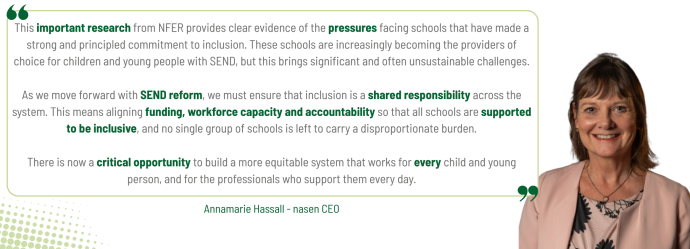
This important research examines how pupils with special educational needs and disabilities (SEND) are distributed across mainstream schools in England, and the impact of this on pupils, families, and schools
What the research tells us
- SEND is increasingly concentrated
Pupils with SEND are not evenly distributed across schools.
Some schools have significantly higher proportions of pupils with SEND and EHCPs, with the gap between schools widening. - Inclusive schools are carrying greater demand
Schools with strong inclusive values and practice are more likely to attract and admit pupils with SEND. - System pressures are shaping placement decisions
Delays in EHCP processes, shortages in specialist provision, and urgent need lead to mainstream schools being used as default placements, particularly where they are already inclusive. - A cycle of inequality is emerging
Schools with higher concentrations of SEND face increasing pressure.
Other schools may be less able or willing to admit pupils with SEND, further reinforcing imbalance across the system. - Pressures on schools are unsustainable
High-SEND schools often demonstrate strong inclusive practice but face: Increased workload, Financial strain, Greater complexity of need - Inclusion bases are not a standalone solution
SEN units and resourced provision can support inclusion, but are not sufficient on their own and vary in effectiveness due to resource and staffing challenges.
What this means for the system
- Inclusion is currently uneven and not yet a shared responsibility across all schools.
- Schools leading inclusive practice are disproportionately supporting the system.
- Without action, these patterns risk becoming further embedded.
There is an urgent need for:
- More equitable distribution of SEND across schools
- Timely and effective support systems
- Investment in workforce and leadership capacity
- Alignment between funding, accountability and inclusion
nasen view
nasen welcomes this research as a clear articulation of challenges already recognised across the sector.
The evidence reinforces the need for:
- A system-wide approach to inclusion, where responsibility is share
- Sustainable investment in schools, staff and specialist provision
- Policy reform that enables every school to be inclusive, not just some
Next steps for sector networks
We encourage colleagues and partners to:
- Read and share the report findings across your networks
- Use this evidence to inform local planning and partnership work
- Continue to champion inclusive practice and workforce development
Engage with SEND reform discussions, ensuring the voice of the sector is heard